
.avif)

Why Courts Fail in Florida, and How to Read the Cracks
Six crack patterns, what each one tells you about the layer underneath, and how to tell a repair from a resurface from a rebuild. Written for boards and property managers rather than engineers.
.avif)
Most money wasted on courts is wasted the same way. A court starts cracking. Someone gets three bids to resurface it. The cheapest crew pressure washes, fills the cracks, rolls on new color and paints the lines. It looks excellent for about eighteen months. Then the same cracks come back in the same places, because nothing that was actually broken got fixed.
This guide is about how to avoid that. It covers why Florida courts fail differently from courts in the rest of the country, how to read a crack pattern well enough to know which layer has gone, and how to tell whether you are looking at a repair, a resurface or a rebuild before you ask anyone for a price.
None of it requires an engineering background. The patterns are distinctive once you know what you are looking at, and you can check most of them yourself in twenty minutes with a straightedge and a coin.
01
Florida fails differently
Almost everything published about court failure was written for a northern climate, where the enemy is the freeze and thaw cycle. Water gets into a crack, freezes, expands and widens it. Repeat a hundred times a winter and the pavement comes apart.
Florida has essentially none of that. Which means most of the standard advice is answering a question your court does not have, and it is worth knowing when a contractor quotes it at you.
What actually attacks a court here is water from underneath. Much of Florida sits on sand over limestone with a high water table, and takes something on the order of fifty inches of rain a year, most of it in a concentrated wet season. A court is typically built on a compacted limerock base. When the water table rises into that base, or surface water drains into it instead of off it, the limerock loses strength. Saturated base material under repeated load does not hold its shape. It ruts, it develops soft spots, it begins to flex.
A slab or an asphalt mat that flexes will crack. Not because the surface was poor, but because the thing underneath it stopped being rigid. This is why two courts built the same week by the same crew can diverge completely within five years. One of them drains and the other does not.
The practical consequence
Fix drainage first, then the pavement. In that order, always. A perfectly built court on a base that holds water will fail again on schedule. A modest court that drains properly will outlast it by years.
It also means the single most useful question about a cracking court is not how bad the cracks look. It is where does the water go.
02
Reading the cracks
Crack width tells you very little. Contractors quote width because it is easy to measure and easy to put in a proposal. Pattern is what matters, because the pattern tells you which layer failed, and the layer decides whether you are spending a little or a lot.
Six patterns cover most of what you will find on a Florida court. Walk the whole surface, not just the spot someone complained about, and look for which of these you have. Many courts have more than one.
Fine, tight, irregular web
Surface layer only
Crazing, or map cracking
A fine web of shallow cracks, often tight enough that you notice them only in raking light or after rain. They sit in the coating or the top millimeter of the slab and do not continue down into it.
Usually a coating problem rather than a structural one. Coating applied too thick, applied in heat that flashed the surface before it could cure evenly, or simply old and brittle from a decade of ultraviolet exposure.
What it means
This is the good news pattern. The court underneath is likely sound and a proper resurface will genuinely fix it.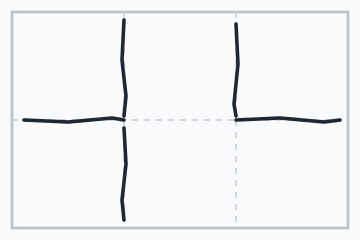
Straight, following the joint grid
Slab movement at a designed joint
Cracking along control joints
Straight cracks that follow a regular grid, lining up with the saw cuts or construction joints in the slab. They are often the most visible cracks on the court and the most alarming to look at, which makes them the ones boards ask about first.
Control joints exist so the slab cracks where you chose rather than where it likes. A crack appearing in one is doing its job. The problem is not the crack, it is what happens when it is filled with the wrong material and simply coated over, because the joint will keep moving and the coating will keep splitting.
What it means
Manageable, but it needs proper joint treatment rather than crack filler and paint. Ask specifically how the bidder intends to handle joints, and be skeptical of an answer that is only a product name.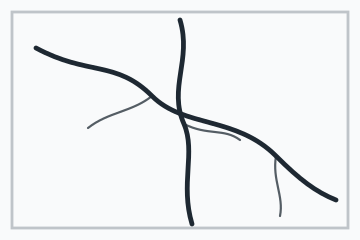
Few, wide, wandering, ignores the grid
Through the slab
Structural cracking
A small number of wide cracks that wander across the court and pay no attention to the joint grid. Often one dominant crack with smaller branches. They go through the full thickness of the slab rather than sitting in the surface.
Causes vary and genuinely need looking at. Reinforcement placed too shallow or too deep, a soft spot in the subgrade, a slab poured in conditions that cured it unevenly, or settlement under one area. Sometimes a tree root. If the two sides of the crack sit at different heights, something below has moved and that is the more serious reading.
What it means
Needs assessment before anyone quotes a surface. A resurface over an active structural crack will telegraph through within a season or two, and you will have paid for a surface twice.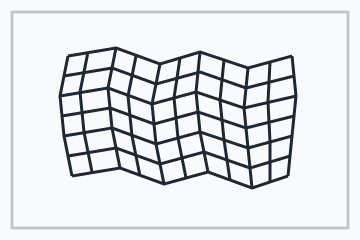
Dense interconnected polygons
The base has failed
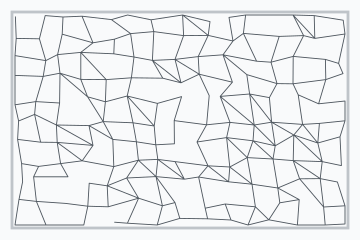
Alligator cracking
Interconnected cracks forming many small irregular polygons, usually concentrated in a region rather than spread evenly over the court. The nickname comes from the resemblance to hide. On asphalt it is the classic fatigue pattern. It almost always appears in the areas that take the most load or hold the most water.
This is the pattern that means the base underneath has lost its load bearing capacity. It is what saturated limerock looks like from above after a few wet seasons of flexing under use. Press on the area with your heel. If it feels like it gives slightly, that confirms it.
What it means
Coating over this is the most expensive mistake available, because it hides the problem without slowing it and the money is simply gone. Correct the drainage and rebuild the affected base. Partial reconstruction is often possible if the area is contained.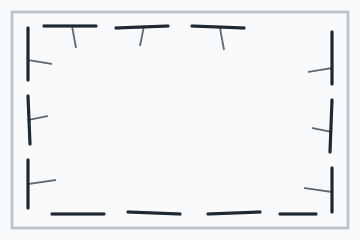
Concentrated at the perimeter
Unsupported or undermined edge
Edge cracking
Cracking that runs parallel to the perimeter, usually within a foot or so of it, sometimes with short cracks branching inward. Often accompanied by the very edge crumbling, or by a visible lip where the court meets the surrounding grade.
Two common causes, and they frequently occur together. The edge was never adequately supported, so it carries load it was not built for. Or surface water runs along the perimeter rather than away from it and has been quietly undermining the base from the side. Look at what happens to water at the low edge of the court, and at whether the adjacent grade slopes toward the court or away.
What it means
Usually repairable, and usually a drainage symptom rather than a court problem. Worth catching early, because the undermining progresses inward.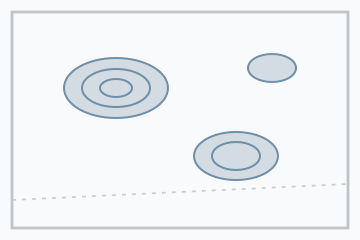
Standing water after drainage stops
Slope or settlement
Ponding, or birdbaths
Not a crack, and the most reliable single indicator you have. Flood the court or walk it after rain, wait until it has stopped draining, and look for water that stays. The American Sports Builders Association defines a birdbath as standing water deeper than one sixteenth of an inch, and the field test is exactly as simple as it sounds. If the water covers a nickel laid flat, it is too deep.
Ponding means the surface is not in a true plane, either because the slope was wrong from the start or because something has settled since. Water that sits also accelerates everything else on this list, because it is the mechanism that gets water into the base.
What it means
Coating does not fix slope. It is roughly a sixteenth of an inch thick, which is the entire tolerance you are trying to correct. Ponding needs patching, grinding, or in a bad case reconstruction of that area.One honest caveat
Even a properly built court can develop some birdbathing over years of service, and ASBA says so explicitly. A single shallow low spot on a fifteen year old court is not evidence that anyone did anything wrong. Widespread ponding, or ponding alongside alligator cracking, is a different conversation.
03
What good looks like, numerically
These are the tolerances a finished court should meet. They are not a Courtforge invention, they come from surfacing manufacturer specifications and standard industry practice, and the reason to know them is that they let you replace an argument about quality with a measurement.
What
Standard
How it is checked
Slope
0.83% to 1.00% (1:120 to 1:100)
In a true plane, in one direction, side to side preferred. Measured on a grid with a laser or digital level
Planarity
Within 1/8 in. over 10 ft
A ten foot straightedge laid in any direction, including diagonals. Measure the largest gap underneath it
Ponding
Less than 1/16 in.
The nickel test, once drainage has ceased or after an hour of drying in sun
Concrete strength
3,000 psi min. at 28 days
Cylinder break by an independent lab. Ask for the report
Cure before coating
28 days concrete, 30 days asphalt
Elapsed time from placement. Not negotiable and not weather dependent
Coating coverage
Manufacturer rate, undiluted
Gallons used against square footage against the published rate, per coat
The one on that list nobody checks
Coverage rate. Over thinning coating to stretch material is the most common hidden defect in the trade, it is invisible at handover, and it takes years off the surface. The arithmetic is simple. Gallons purchased, square feet covered, coats applied, against the rate printed on the pail.
Ask any bidder to provide a material reconciliation at closeout. A crew doing it right will not mind. The reaction to the question tells you something either way.
04
Repair, resurface or rebuild
Three different answers at three very different costs, and the patterns above mostly decide which one you are in. The common error is reaching for resurface by default, because it is the middle option and sounds prudent.
Option
Right when
Wrong when
Repair
Localized damage on an otherwise sound court. A contained area of edge cracking, one or two structural cracks that are not moving, a single birdbath
Used repeatedly to defer a decision. Three repairs in five years is a rebuild that nobody has approved yet
Resurface
Base is sound, slope is within tolerance, and the problem is genuinely in the surface. Crazing, worn color, faded lines, light joint cracking properly treated first
There is alligator cracking, active structural movement or ponding. Coating is a sixteenth of an inch and corrects nothing structural
Rebuild
Base failure over a meaningful area, slope well outside tolerance, or a court that has already been resurfaced over a known problem once
Sold on the strength of dramatic looking joint cracking alone. Some courts look far worse than they are
The number that makes the comparison honest
Bids are usually compared on price, which systematically favors the option that fails soonest. The comparison that holds up is annual cost per year of service life. Divide the price by the years you can reasonably expect before the next intervention.
A resurface at a low number that lasts three years because it went over a failing base costs considerably more per year than a reconstruction at a high number that lasts fifteen. That is the figure to put in front of a board, and it is the one that survives the question of why the cheapest bid was not chosen.
It is also the figure that sits naturally beside a reserve schedule, because a reserve study is already thinking in terms of remaining useful life. You are speaking the same language rather than translating.
05
Seven questions for anyone bidding
These are not trick questions. They are the things a competent builder answers easily and an incautious one answers vaguely, which is most of the information you need.
1
What is the slope now, and what will it be when you finish?
Expect numbers, in percent. A bidder who has not measured the existing slope has not assessed the court.
2
Where does water currently go, and what are you changing about that?
In Florida this is the question. If drainage is out of scope, that should be stated plainly rather than left unmentioned.
3
What does the crack pattern tell you about the base?
You are listening for whether they distinguish between patterns at all, or treat every crack as a filling job.
4
What tolerances will the finished court meet, and will you put them in the contract?
Slope, planarity, ponding. Acceptance criteria in writing are enforceable at handover, while you still hold final payment. A warranty is only useful after something has already failed.
5
What coverage rate, and will you reconcile material at closeout?
The hidden defect question. See section three above.
6
What is excluded from this price?
The most useful question for comparing bids. Low bids are usually not cheaper, they are smaller, and the difference lives in the exclusions rather than the line items.
7
What would you tell me if you were not bidding on this?
Occasionally the right answer is that the court has several good years left and the money belongs somewhere else. Worth finding out who is willing to say so.
06
Checking it yourself
Twenty minutes, and you will know more about your court than most of the bids you receive will tell you.
1
Walk the whole surface
Note which patterns from section two you can find, and roughly where. Photograph each one with something in frame for scale.
2
Lay a ten foot straightedge
In several places and directions, including diagonally. Anything over an eighth of an inch of gap is out of tolerance.
3
Flood a few areas
With a hose, or walk it after rain. Wait for draining to stop. Lay a nickel in any water that remains. If it disappears, that is a birdbath.
4
Press your heel into any alligator cracked area
Give or sponginess means the base, not the surface.
5
Look at the perimeter
Does the adjacent grade fall away from the court or toward it. Is there a lip. Is the edge intact.
Take the photographs and notes into every bid conversation. It changes the discussion from what a contractor would like to sell you into what your court actually needs, which is a better conversation for everyone who intends to do the work properly.
If you would rather not
Courtforge does this as a Court Condition and Compliance Report, at no charge and with no obligation. Measured slope and planarity against published tolerances, ponding by the nickel test, a photographed crack map with each pattern identified by failure mode, and a repair versus resurface versus rebuild recommendation with an annual cost per year of service life.
Where a court is fine, the report says so in writing. That is a legitimate outcome and roughly as useful to a board as any other.
Tolerances above are drawn from surfacing manufacturer specifications and standard industry practice. The American Sports Builders Association publishes its own construction tolerances, which govern wherever a contract names them. Last reviewed October 2026.
Not sure what your cracks are telling you?
We will come and measure it. Slope, planarity and ponding against published tolerances, a crack map by failure mode, and a repair versus resurface versus rebuild recommendation. No charge. Where a court is fine, we say so in writing.
.avif)
.svg)
.svg)
.svg)
© 2026 Courtforge Group Florida LLC. All rights reserved.